




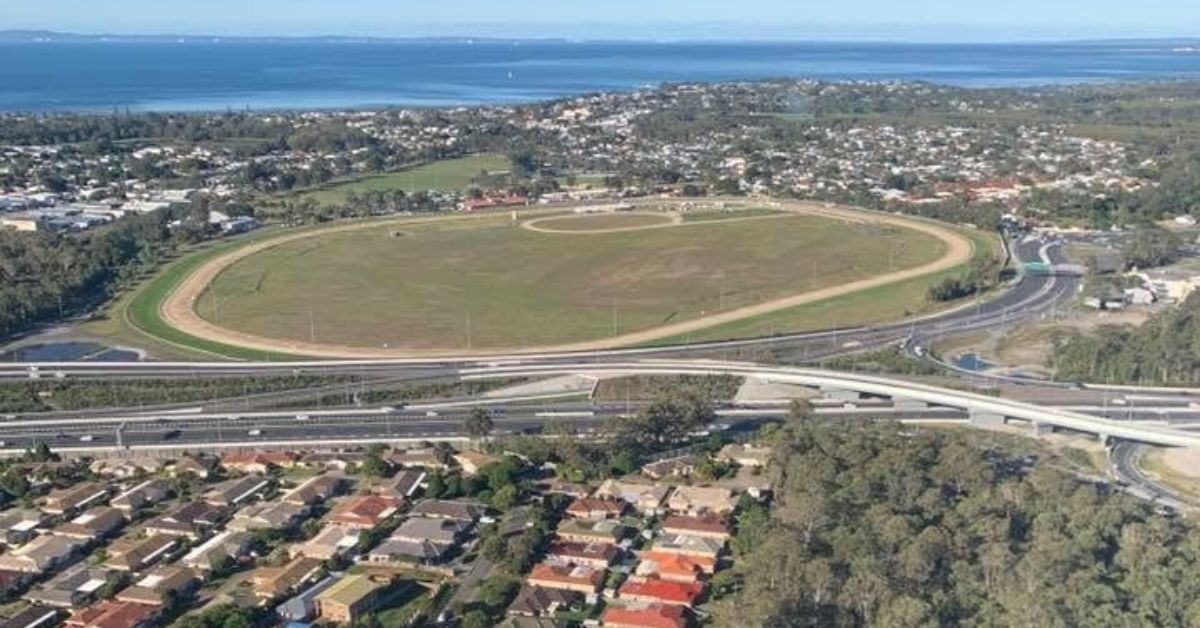
In the winter of 1924, Deagon Racecourse staged one of the stranger spectacles in its long life: a Harley-Davidson and the Ascot Garage aeroplane taking each other on. That moment, recorded in Brisbane City Council’s heritage citation for Deagon Racecourse, says a lot about the place. Deagon has never been just a track. It has been a racecourse, a showground, a motorcycle circuit, a training ground and, one of Sandgate’s most durable landmarks.
Now its future is being talked about again. The Queensland Government’s The Next Lap reform program says Racing Queensland is engaging on Deagon’s future. But the documents verified for this story do not confirm a sale, a closure or a redevelopment. They confirm only that the site is under review and that the conversation is continuing.
For the people around Deagon, that is enough to stir old questions. The racecourse has long been part of the district’s identity. It is still listed by Brisbane City Council as a local heritage place at 133 Board Street, Deagon.
The day a Harley-Davidson took on an aeroplane
Deagon’s story begins in the early 1880s, when Sandgate was growing as Brisbane’s seaside escape. By 1885, the Sandgate Amateur Turf Club was already holding full race meetings, including a St Patrick’s Day programme of seven races. A few years later, in 1890, an area of 87 acres 22 perches was granted to the club’s trustees. This helped secure the racecourse’s place in the district’s landscape.
The site’s early fortunes were mixed. By the turn of the 20th century, the racecourse had been sold by the mortgagee. In 1911, it was bought by John Wren and Benjamin Nathan for £2,800. From there, Deagon moved through one of the most unusual chapters in Queensland racing history.
The heritage citation records that the racecourse became a regular venue for motorcycle racing in the 1920s and 1930s. It also notes that in July 1924 the main event was a race between a Harley-Davidson and the Ascot Garage aeroplane. That single episode captures the site’s odd magic: a place built for horses that could also be swept into the thrills of early motor sport.
The trainers and stables that shaped Deagon
Deagon’s current role is quieter, but it still matters. The heritage citation says the racecourse was refurbished and reopened for horse racing in 1938. In 1982, it was registered as a racehorse training facility. Since then, it has remained part of Queensland’s racing infrastructure.
That long working life is part of why Deagon still matters to Sandgate. The racecourse is not just an old site with a famous name. It is a place shaped by trainers, stable hands, horses and the routines that come with them. The heritage citation also points to the 1946 residence at 84 Board Street associated with trainer John Thomas Nixon and stables, showing how closely the racecourse has been tied to the surrounding neighbourhood.
The broader setting matters too. Deagon is not an isolated tract of land waiting for reinvention. It sits inside a suburb that has grown alongside it, and the racecourse has helped shape local identity as much as local development has shaped the site.
An earlier vision for the precinct
This is not the first time Deagon has been the subject of a future plan. In 2019, Racing Queensland outlined a concept that would turn the site into a state training centre and explore broader uses alongside racing. That direction was set out in RQ advances Deagon master planning and reported at the time by Mirage News.
The plan then was for an “equine precinct” with possible additions such as community sport, markets, dining, retail, entertainment and accommodation. In other words, the idea was renewal within racing, not a sale. That distinction matters now because the current reform discussion is different. The latest The Next Lap update speaks about engagement and future direction. But it does not lock in an outcome for Deagon.
That uncertainty is also reflected in Question on Notice No. 351. Here, the government response confirms that an implementation plan had been delivered, but says it remains subject to Executive Government consideration. What was not answered publicly is just as important as what was: there is still no formal public detail on consultation dates, final decisions or any privatisation pathway.
Another uncertain chapter in a long history
So Deagon sits, once again, between history and decision. It has already been a seaside racecourse, a mortgagee sale, a motorcycle track, a reopened horse venue and a training centre. Each time, it has survived by changing shape without losing its name.
That is why the story is bigger than one reform program or one possible land-use decision. Deagon’s history is the story of a place that has repeatedly adapted to new pressures while keeping its connection to Sandgate. The heritage listing makes clear how deeply the site is woven into the city’s sporting and social history.
For now, the most accurate thing that can be said is the simplest: Deagon Racecourse is still here, still significant and still waiting for its next chapter.
Published 17-November-2026