




By Jack Mercer – Rabbit Hole Fisherman
Phil Collins’ most famous drum break owes its distinctive sound to recording experiments during a Peter Gabriel album session. A microphone intended for studio conversations helped popularise a technique that would become a hallmark of 1980s music.
Phil Collins’ In the Air Tonight helped popularise one of the most recognisable recording sounds of the 1980s. Its origins can be traced to experiments involving a studio communication microphone, a heavily compressed audio signal and two former Genesis bandmates exploring new musical possibilities.
In This Story
- Two Former Genesis Bandmates
- The Townhouse’s Accidental Discovery
- The Science Behind Gated Reverb
- From a Home Demo to Face Value
- The Power of the Delayed Drum Break
- The Drowning Legend Collins Rejected
- A Defining Sound of the 1980s
- The Recording’s Unexpected 2020 Revival
- From Intruder to In the Air Tonight
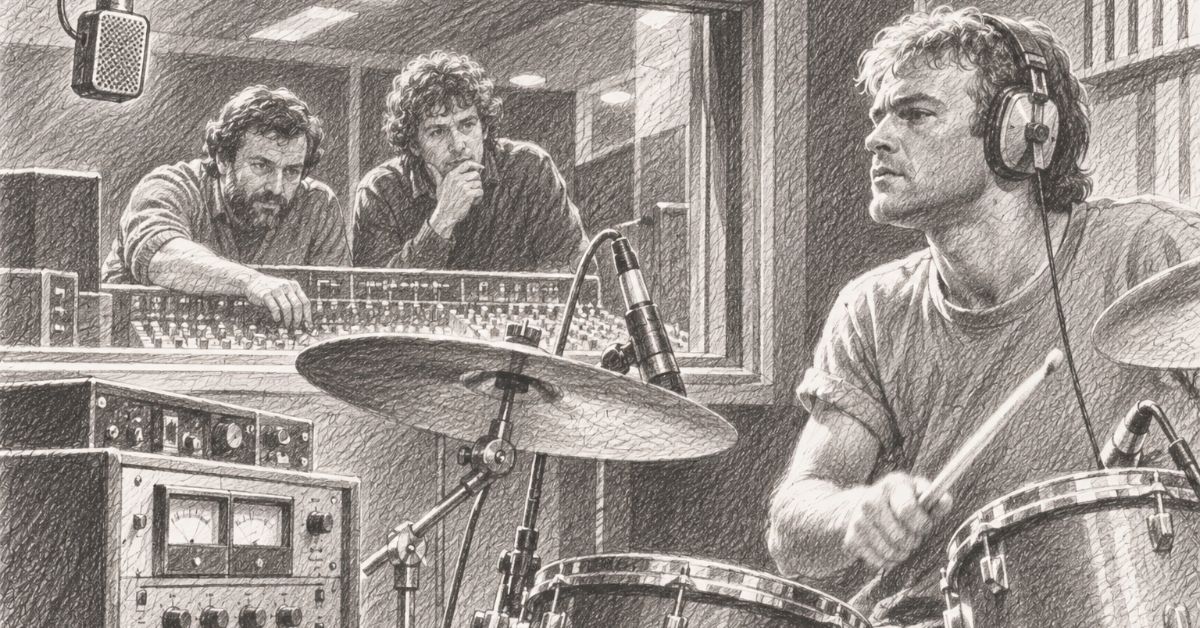
During sessions for Peter Gabriel’s third solo album at London’s Townhouse Studios, recording engineer Hugh Padgham heard Collins playing drums through a microphone intended to allow communication between the recording room and the control room.
The microphone’s associated circuitry produced a powerful drum sound, capturing the acoustic character of the room in an unexpected way. However, the mixing desk was not configured to send that particular signal to the recording equipment.
As Padgham recalled in a January 1985 interview with Home & Studio Recording, the console had to be modified to allow the engineers to record the sound.
The experiments helped shape Gabriel’s 1980 recording Intruder and laid the groundwork for the distinctive drum production on Collins’ breakthrough solo single the following year.
Two Former Genesis Bandmates
Collins and Gabriel had spent several years making music together in Genesis. Gabriel left the group in 1975, and Collins subsequently became its lead singer while continuing to play drums.
By the late 1970s, Genesis was attracting a broader international audience. The success of Follow You Follow Me in 1978 marked a shift towards shorter, more accessible songs alongside the group’s progressive rock compositions.
Away from Genesis, Collins was experiencing the breakdown of his first marriage. He began developing songs at home that would eventually form part of his debut solo album, Face Value, while continuing to work with other musicians, including Gabriel.
Gabriel’s third solo album, released in 1980 and commonly known as Melt, was produced by Steve Lillywhite and engineered by Padgham. Its recording sessions encouraged experimentation, including Gabriel’s instruction to avoid conventional cymbal playing.
Without the sustained metallic sound of cymbals, the drums could occupy more space in the arrangement.
The album’s opening track, Intruder, developed around a repeating rhythm performed by Collins. In a later interview with The Quietus, Gabriel recalled programming a rhythmic pattern and also acknowledged that Padgham had experimented with related recording effects during earlier work with XTC.
The Townhouse sessions were therefore an important stage in the development of the technique rather than necessarily its absolute starting point.
The Townhouse’s Accidental Discovery
Recording studios generally separate musicians from the engineers and producers operating the recording equipment. Communication between these spaces is essential, particularly when musicians need instructions or wish to discuss a performance.
Townhouse Studios had a mixing console manufactured by the British company Solid State Logic (SSL). Among its features was a reverse talkback system, also known as listenback, which allowed people in the control room to hear conversations in the recording room.
The system incorporated a powerful audio compressor designed to make speech audible even when someone was standing some distance from the microphone.
Compression reduces the difference between louder and quieter sounds. When Collins played his drums, the heavily compressed signal made the acoustic reflections from the recording room particularly prominent.
Padgham was hearing more than the direct sound of the drum kit. The reflections from the surrounding surfaces contributed to a sense of scale that was difficult to achieve through conventional close-microphone recording alone.
The communication microphone had revealed an unexpected recording possibility. Padgham and Lillywhite developed related techniques using room microphones, compression and noise gates to control the resulting sound.
The Science Behind Gated Reverb
A drum struck in a reflective room produces both an immediate impact and a series of acoustic reflections. Those reflections continue after the initial strike, creating reverberation.
Compression can make the quieter reflections more prominent, giving the recorded drums a greater sense of space. However, prolonged reverberation can also obscure subsequent drumbeats.
A noise gate provides a means of controlling that decay. It allows signals above a selected threshold to pass through and attenuates quieter sounds according to its settings.
When applied to heavily compressed drum ambience, a gate can shorten the reverberation considerably. The drum retains its powerful initial impact, but the surrounding sound disappears more abruptly than it would naturally.
The technique became widely known as gated reverb, although similar effects can be achieved using either natural room ambience or electronically generated reverberation.
In an April 1987 interview with Music Technology, Padgham described his approach to combining close and distant microphones to capture drums with a greater sense of physical presence.
The accidental discovery provided the inspiration, while subsequent recording experiments made the effect a practical production technique.
From a Home Demo to Face Value
While Gabriel was developing his third solo album, Collins was exploring his potential as a songwriter outside Genesis.
He had assembled recording equipment at home, including a Roland CR-78 drum machine, which allowed him to create repeating electronic rhythms while developing keyboard parts and experimenting with vocals.
The early version of In the Air Tonight combined electronic percussion, synthesiser sounds and a vocal performance that emerged largely through improvisation.
Collins has explained that the song reflected the emotions he was experiencing during the breakdown of his marriage. Rather than beginning with a predetermined story, he developed much of the vocal material as he sang.
The result was a song conveying anger, hurt and uncertainty without explicitly identifying the circumstances behind those emotions.
Collins subsequently worked with Padgham to develop the recordings for Face Value, which they co-produced. The production retained the electronic rhythm that characterised the early version of In the Air Tonight, while introducing acoustic drums at a carefully chosen point in the arrangement.
The contrast between those two percussion sounds became central to the recording’s identity.
The Power of the Delayed Drum Break
Recording engineer Nick Launay was assisting Padgham during the making of Face Value.
In an October 2007 feature published by Mix, Launay recalled being present when Collins recorded the acoustic drums for In the Air Tonight. Padgham had prepared the drum sound, and Launay operated the recording equipment.
Launay remembered being startled by the force of the drums coming through the studio monitors when Collins began playing.
For much of the recording, electronic percussion provides a restrained rhythm beneath the keyboards and vocals. The arrangement establishes a consistent atmosphere before the acoustic drums enter during the latter part of the song.
The drum break is effective partly because of that contrast. Its impact depends not only on the size of the recorded sound but also on the relative restraint of the preceding minutes.
Had the acoustic drums been present throughout the recording, their entrance would not have provided the same dramatic change.
The recording demonstrates how musical arrangement and studio technology can reinforce each other. The equipment helped create the sound, but the placement of the drum break gave it much of its significance.
The Drowning Legend Collins Rejected
Few recordings from the period have attracted an urban legend as persistent as the one associated with In the Air Tonight.
The story alleges that Collins witnessed a drowning during which another person failed to intervene. More elaborate versions describe a supposed confrontation at one of his concerts.
Collins has repeatedly rejected these accounts.
In a February 2016 interview with the Associated Press, he discussed the improvised origins of the lyrics and dismissed the drowning story.
There is no substantiated evidence connecting the recording to such an incident.
The legend nevertheless became sufficiently established in popular culture for American rapper Eminem to reference it in his 2000 recording Stan.
The ambiguous lyrics and dramatic musical arrangement may have encouraged listeners to search for a specific narrative behind the song. Collins’ own explanation, however, places its origins in the emotional circumstances surrounding the breakdown of his marriage rather than an extraordinary incident involving a stranger.
A Defining Sound of the 1980s
In the Air Tonight entered the British singles chart in January 1981 and reached No. 2, according to the Official Charts Company.
Its success helped establish Collins as a solo artist independently of his continuing work with Genesis.
For recording engineers and producers, the song also demonstrated the commercial possibilities of unconventional drum production.
Padgham later recalled that he and Lillywhite had become dissatisfied with some of the comparatively dry drum sounds associated with earlier recordings. They wanted to capture more of the physical presence of a drum kit being played in a room.
By 1987, Padgham was receiving requests to reproduce the sound associated with his earlier recordings, even as he was exploring different production approaches.
Other engineers and producers developed variations using natural room acoustics, compression, noise gates and electronic reverberation. Large drum sounds with shortened reverberation became familiar features of rock and pop production throughout the decade.
Recording engineers had experimented with these technologies before the Townhouse sessions. The achievement of Gabriel, Collins, Padgham and Lillywhite was not the invention of every component of gated reverb, but their contribution to its development and popularisation.
The Recording’s Unexpected 2020 Revival
Nearly four decades after its original release, In the Air Tonight experienced renewed commercial interest through an online reaction video.
American twins Tim and Fred Williams filmed themselves listening to the recording as part of their music reaction series. Their response to the acoustic drum entrance attracted widespread attention.
According to the MRC Data and Billboard 2020 year-end report, US streams increased by approximately 122 per cent between the three-day periods of 4–6 August and 7–9 August 2020. Digital downloads increased by approximately 1,516 per cent over the same comparison periods.
The resurgence demonstrated that a recording released in 1981 could still generate substantial interest through contemporary digital platforms.
The Williams brothers’ reaction also illustrated the continuing effectiveness of the original arrangement. The contrast between the restrained electronic rhythm and the sudden arrival of acoustic drums remained central to the listening experience.
From Intruder to In the Air Tonight
Heard together, Gabriel’s Intruder and Collins’ In the Air Tonight demonstrate two different musical applications of related recording techniques.
On Gabriel’s recording, the repeating drum pattern contributes to an unsettling atmosphere. Its compressed ambience and shortened decay help establish the character of the song from the outset.
Collins used a similarly powerful drum sound more sparingly. The acoustic percussion arrives after an extended period of electronic rhythm, creating a dramatic change in the arrangement.
The difference illustrates the importance of musical decisions beyond the recording equipment itself. A distinctive sound can serve different purposes depending on its relationship with the other instruments and the structure of a composition.
Padgham and Lillywhite explored the recording possibilities, Gabriel developed them within his own music, and Collins brought a related sound to a wider audience through his solo work.
At the centre of that history was a microphone installed for an entirely different purpose. Designed to help people communicate across a recording studio, it became part of an experiment that helped shape the sound of a musical decade.