




By Jack Mercer – Rabbit Hole Fisherman
The nail in the original Ashdown pineapple peeler tells much of the story behind a kitchen gadget developed by Brisbane inventor Ray Ashdown in 1971. Within two years, his design had appeared on national television and secured a United States patent bearing a Kedron address.
In This Story
- A Nail, Two Blades and a Kitchen Problem
- The Kedron Design Behind a US Patent
- From Television to Overseas Markets
- A Shop Counter at the Big Pineapple
- From Kitchen Gadget to Museum Collection
A Nail, Two Blades and a Kitchen Problem
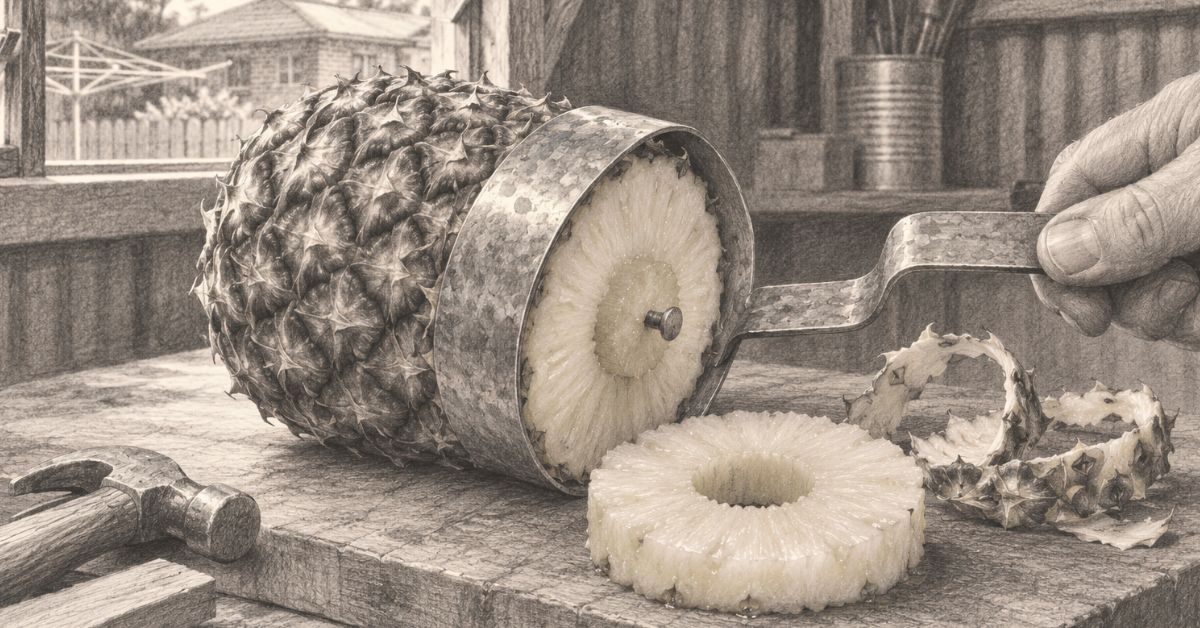
Among the objects documented by Queensland Museum is Ashdown’s original prototype, made from galvanised steel. A nail at one end served as a pivot, allowing two blades to travel around the fruit at different distances from its centre.
The inspiration came from watching his wife struggle to prepare a pineapple. In an ABC interview in 2023, Ashdown recalled experimenting in his workshop with a piece of metal and two nails. His wife was surprised by the result.
Preparing a pineapple involved several separate tasks. Its tough skin had to be removed without sacrificing too much flesh, while the fibrous core needed to be cut away. Ashdown’s design brought the peeling and coring operations together.
The Kedron Design Behind a US Patent
The engineering behind the invention is recorded in US patent 3,769,706, which identifies Raymond George Ashdown as the inventor and Ashdown Inventions Pty Ltd as the patent assignee. Both were listed in Kedron.
The application was lodged on 12 October 1972 and the patent granted on 6 November 1973.
Ashdown used the exposed centre of the pineapple as an anchor for a rotating cutter. The mechanism incorporated an adjustable outer blade, a guide and a second blade positioned near the core. Together, they separated the edible flesh from the surrounding skin and central core. A separate knife completed the slice.
Pineapple-peeling devices already existed. The patent refers to earlier American inventions dating from 1916 and 1921. Ashdown’s contribution was his particular arrangement of the cutting mechanism.
From Television to Overseas Markets
Queensland Museum records Ashdown’s appearance on ABC television’s The Inventors in 1972.
Although he did not win, Ashdown recalled receiving letters from viewers disappointed with the result. His television appearance was followed by a manufacturing arrangement with a Sydney factory.
According to Ashdown, production continued for about five years, with the device reaching customers in Japan, Britain and the United States.
Its suitability varied between markets. Ashdown remembered encountering difficulties in Hawaii, where some pineapples were too large for his device.
A Shop Counter at the Big Pineapple
One of the natural markets for the Ashdown pineapple peeler was the Sunshine Coast’s Big Pineapple, which opened at Woombye in 1971 as part of the Sunshine Plantation.
The attraction introduced visitors to Queensland’s tropical fruit industry, combining agricultural exhibits with tourism.
Ashdown remembered staff demonstrating his invention to visitors, some of whom purchased several peelers during their visit.
The financial rewards were less certain. His son Don recalled that patent-related fees and marketing expenses limited the invention’s impact on the family’s circumstances. Eating pineapple, however, became something of a family tradition.
An independently verified total for the number of peelers manufactured or sold has not been established.
From Kitchen Gadget to Museum Collection
Pineapples remain part of Australia’s agricultural industry. Hort Innovation’s 2024/25 statistical handbook recorded national production of 68,373 tonnes, with 47,157 tonnes entering fresh supply.
Queensland Museum now documents both Ashdown’s handmade prototype and a commercially manufactured version, preserving the development of an everyday household invention.
The nail remains visible in the photograph of the original device. Ashdown had found a practical use for the very part of the pineapple he wanted to remove: its core provided the anchor around which his cutter could turn.