




By Jack Mercer – Rabbit Hole Fisherman
Australia exports almost all the crude oil it produces but imports most of the refined petroleum it consumes. In the Pilbara, electric mining trucks are testing whether some of that dependence can be reduced.
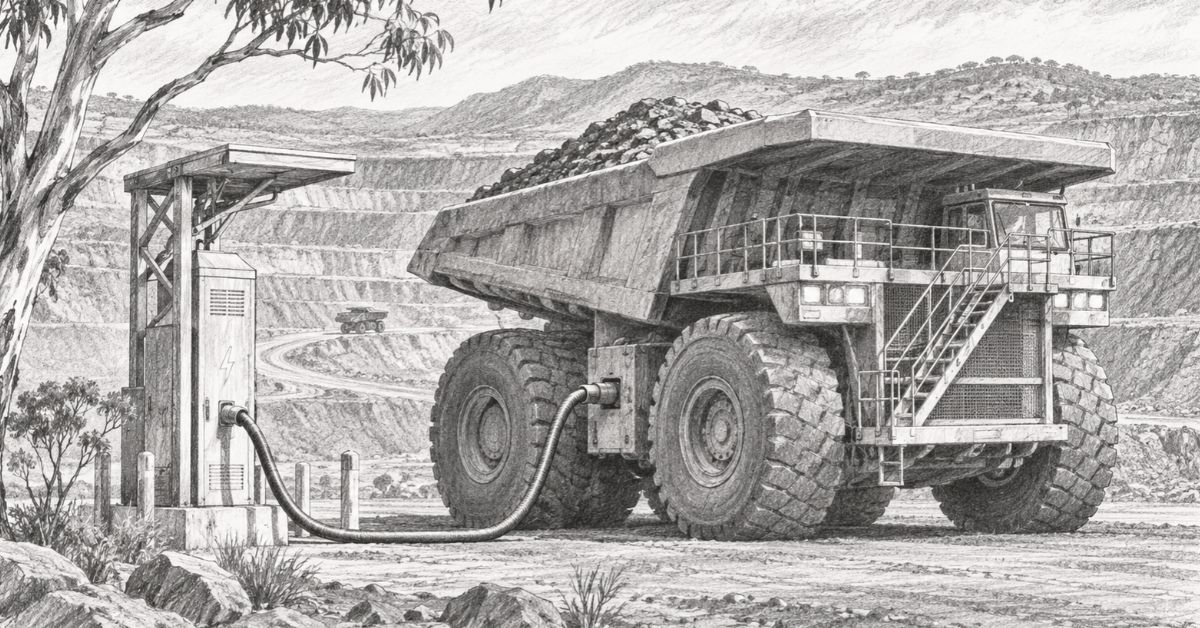
Australia’s diesel dependence is facing an unusual test at BHP’s Jimblebar iron ore mine in Western Australia, where two battery-electric Caterpillar haul trucks are undergoing trials that could have implications well beyond mining.
In This Story
- Australia’s Reliance on Imported Diesel
- China’s Electric Truck Market
- Six-Megawatt Charging in the Pilbara
- The Limits of Farm Electrification
- From Fuel Imports to Equipment Imports
- The Commercial Test for Electric Haulage
In June 2026, BHP, Rio Tinto and Caterpillar reported that the vehicles had completed more than 200 test laps and accumulated over 100 operating hours. Testing on a dedicated track is helping engineers assess charging, reliability and performance in Pilbara conditions.
The trial remains a proof of concept. Replacing an entire diesel-powered fleet economically is a considerably larger challenge.
Australia’s Reliance on Imported Diesel
Australia is a major exporter of coal and natural gas, yet much of the liquid fuel used by its farms, mines, freight operators and construction companies comes from overseas.
Australian Government energy statistics show that imports supplied 80.8 per cent of refined petroleum consumption in 2024–25, while 95.7 per cent of domestic crude oil production was exported. Australian refineries also imported about two-thirds of their feedstock.
Part of the explanation lies in the differences between the crude oil Australia produces and the feedstock required by its remaining refineries. These trading arrangements expose Australian businesses to international fuel prices and overseas supply disruptions.
Under Australia’s Minimum Stockholding Obligation, regulated fuel suppliers must maintain minimum reserves. In the June quarter of 2026, government statistics showed that diesel stocks covered by these arrangements averaged the equivalent of 36 days of normal consumption.
That figure is not a prediction of how long Australia would function after a complete interruption to imports. Domestic refining, emergency measures and changing consumption would affect the outcome.
Alongside storage and supply diversification, reducing fuel consumption offers another way to address Australia’s diesel dependence.
China’s Electric Truck Market
The International Energy Agency’s Global EV Outlook 2026 reported that approximately one-quarter of new trucks sold in China in 2025 were electric, compared with nine per cent worldwide.
These figures represent new medium and heavy freight truck sales, not the proportion of electric trucks already on the road.
The IEA found that battery-electric heavy freight trucks in China could match diesel trucks on total ownership costs over five years under certain operating conditions.
Australia faces different circumstances. Charging infrastructure, electricity costs and distances between destinations can significantly affect operating expenses. China’s experience demonstrates commercial viability in some freight applications, but does not establish equivalent economics for Australian long-distance transport or mining.
Six-Megawatt Charging in the Pilbara
Mining haul trucks may carry hundreds of tonnes of material uphill before returning for another load. Charging interruptions must be carefully managed to maintain production.
Fortescue and its partners are developing fast chargers for battery-electric haul trucks in the 240-tonne payload class.
The Australian Renewable Energy Agency-supported project aims to demonstrate industrial charging equipment at an operating Pilbara mine.
Fortescue’s first chargers are rated at six megawatts, or 6,000 kilowatts, with a design objective of charging a haul truck in approximately 30 minutes.
An early engineering report identified a trade-off between compatibility and cost. Components that accommodated a wider range of battery voltages represented approximately one-fifth of the charger’s original design cost. Removing them reduced costs but limited compatibility.
In October 2026, Fortescue reported that its first chargers had been built and that automated connections took less than two minutes. Further testing was planned.
Mines must also establish how many chargers they need, where to install them and whether their electricity networks can support simultaneous charging. Equipment must withstand Pilbara conditions while meeting industrial electrical safety requirements.
The transition remains uncertain. ABC News reported in July 2026 that Rio Tinto continued investing in diesel trucks alongside its electric haulage trials.
The Limits of Farm Electrification
Mining and agriculture face different operating conditions. Mines generally control defined networks of haul roads, allowing charging infrastructure to be concentrated around established routes.
Agricultural machinery may operate across widely dispersed paddocks, far from suitable electricity connections. Harvesters also need to work for extended periods when weather and crop conditions permit, making charging interruptions difficult to accommodate.
The Australian Academy of Technological Sciences and Engineering identifies electrification opportunities in agriculture alongside significant infrastructure and technological challenges.
Smaller machines and stationary equipment, including irrigation pumps, may offer opportunities to reduce diesel consumption before large harvesters can be replaced economically.
From Fuel Imports to Equipment Imports
Electrification would not make Australia completely independent of overseas suppliers. Batteries, vehicles, power electronics and replacement components could remain dependent on international supply chains.
However, electricity can be generated using Australia’s own energy resources. Machinery powered by domestic non-diesel energy sources could reduce exposure to repeated fuel shipments and international diesel prices.
Environmental benefits would depend on electricity generation, battery manufacturing and equipment lifespan. Eliminating diesel exhaust does not eliminate all emissions associated with machinery production and operation.
Electrification could therefore improve one aspect of Australian energy security while creating different infrastructure and supply-chain requirements.
The Commercial Test for Electric Haulage
Australia will continue to need fuel reserves, reliable supply contracts and contingency plans. Existing diesel machinery will remain in service, and some applications may prove particularly difficult to electrify.
For mining companies, commercial viability will depend on vehicle prices, battery life, electricity infrastructure, maintenance, charging delays and the cost of moving material.
If electric haul trucks can eventually move ore at a competitive cost using electricity generated from domestic resources, mining companies will have a commercial reason to consume less diesel.
For Australia, that would mean reducing its exposure to imported fuel without requiring every component of the machinery to be manufactured here.