




By Jack Mercer – Rabbit Hole Fisherman
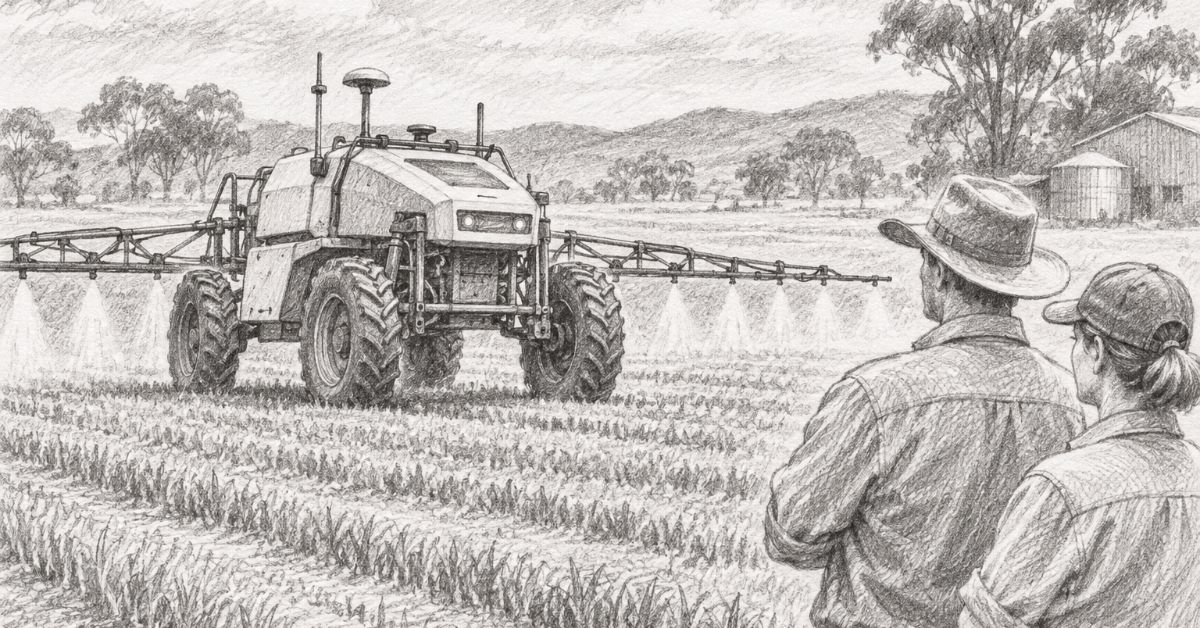
On their Central Queensland farm, Andrew and Jocie Bate began questioning the agricultural machinery industry’s enthusiasm for bigger tractors. Their alternative was autonomous farm machinery: smaller vehicles capable of working independently for extended periods. Today, their idea has become a commercial business, with Queensland farmers reporting substantial savings in agricultural operations.
In This Story
- Challenging the Bigger Tractor Model
- 15,000 Hours on a Queensland Farm
- The Economics of Driverless Spraying
- Removing the Refilling Bottleneck
- A Different Result in Coonawarra
- Beyond the Tractor Cab
The Bates challenged an assumption that had shaped agricultural machinery for generations: increasing productivity required increasingly large and powerful machines.
Their approach was to increase productive working hours rather than continually increase the size of individual machines.
Challenging the Bigger Tractor Model
Farming at Gindie, near Emerald, the Bates began exploring autonomous agricultural technology in the early 2010s.
Large tractors and self-propelled sprayers allowed farmers to cover substantial areas quickly, but they also required significant capital investment and skilled operators.
The Bates envisaged smaller machines working independently across paddocks. With engineering assistance, they developed prototypes that eventually became the foundation of SwarmFarm Robotics.
Rather than designing a machine for a single agricultural task, SwarmFarm developed autonomous platforms capable of carrying different implements, including equipment supplied by specialist manufacturers.
The concept has since progressed from experimental machinery to commercial production, with a manufacturing presence on Queensland’s Darling Downs.
15,000 Hours on a Queensland Farm
The Coggan family’s mixed farming enterprise near Meandarra, in Queensland’s Western Downs, provides an example of autonomous farm machinery operating under commercial conditions.
The business covers approximately 26,300 hectares and introduced its first SwarmFarm robot in 2021, followed by a second in 2022.
Both machines are equipped with 18-metre spraying booms, 3,000-litre tanks and WEED-IT optical spot-spraying technology.
In a September 2026 report by Future Farming, Tom Coggan reported typical chemical savings of around 85% during fallow spraying, reaching 95% under some conditions.
Those savings primarily result from cameras identifying weeds and directing herbicide where needed rather than spraying entire paddocks. Autonomous navigation allows the machines to undertake that work without a dedicated driver.
By October 2026, the two robots had reportedly accumulated approximately 15,000 combined operating hours.
Each machine was covering around 13 hectares an hour while consuming between four and seven litres of diesel, depending on operating conditions.
The Economics of Driverless Spraying
In an October 2026 user review, Coggan estimated that operating costs were approximately 70% lower than conventional spraying.
However, that figure represents one farming enterprise’s reported experience rather than an independently audited comparison of total ownership costs.
Indicative manufacturer prices reported in September 2026 placed a SwarmFarm vehicle at approximately $360,000, with an automatic refilling system costing another $80,000. Implements, software subscriptions, servicing and other expenses also need to be considered.
The machines still require people to undertake maintenance, prepare operating areas and supervise their work.
For a large cropping enterprise with substantial annual machinery use, the investment may make financial sense. A smaller farm with fewer operating hours could reach a different conclusion.
Removing the Refilling Bottleneck
Building a machine that could navigate a paddock independently solved only part of the problem. A sprayer still needed someone to replenish its tank.
SwarmFarm developed AutoFill, a system allowing robots to return to a designated station, refill their spray tanks and resume work.
Coggan Farms introduced the technology in 2025.
At the September 2026 Henty Machinery Field Days, SwarmFarm presented a standalone version intended for compatible conventional spraying equipment as well as its autonomous platforms.
Reducing interruptions could allow machinery to complete more work without tying up staff who might otherwise be needed elsewhere on the farm.
A Different Result in Coonawarra
Not every application has produced favourable results.
A Wine Australia research project, completed in June 2025 and conducted by Treasury Wine Estates, assessed SwarmFarm technology for vineyard operations in South Australia’s Coonawarra region.
Although the machine met core safety, navigation and security requirements, the trial encountered frequent stoppages, sensitive obstacle detection and technical support difficulties.
The trial ended prematurely. Financial modelling based on the limited operating data indicated a negative return for inter-row slashing alone.
The findings do not establish whether those technical problems persist in newer machines. They do, however, demonstrate that autonomous machinery can be technically capable without being economically suitable for every agricultural application.
Beyond the Tractor Cab
In a 2026 innovation profile, the Queensland Government reported that SwarmFarm had delivered more than 250 robots working across more than 10 million acres, equivalent to approximately four million hectares. These deployment figures draw on company information rather than independently audited records.
Research published by Grain Producers Australia also identifies affordability, uncertain investment returns and connectivity as barriers to wider adoption.
Safety remains another consideration. Queensland’s Rural Plant Code of Practice 2024 addresses risks associated with autonomous agricultural machinery. Removing the driver does not remove the responsibility to operate equipment safely.
Conventional tractors remain important for heavy cultivation and other demanding agricultural operations. Smaller autonomous machines offer an alternative for particular tasks rather than a replacement for every piece of farm machinery.
The achievement of Andrew and Jocie Bate lies in demonstrating that agricultural productivity need not depend entirely on building bigger machines.
For some farming operations, increasing the time a smaller machine can work may be just as valuable as increasing its size and power.